Pigmentation Won't Just Disappear… Here's What Actually Works
Summer is magic. The vibes are great, our Vitamin D is hitting the best levels of the year, and the sun makes us happy by keeping our cortisol under control.
That's the dream we have about the hottest, happiest time of year, even if it's never quite that perfect. We're always chasing the sun, always looking for that warm, bright light to make us feel better. But unfortunately, that beloved light is also causing invisible damage if we don't protect ourselves.
Why sunscreen is non-negotiable
UVA and UVB rays are the major cause of skin cancer, which is exactly why protecting your skin with sunscreen is non-negotiable any time you're exposed to the sun. Whether you're at the beach, going for a walk or hike, or doing anything outdoors, sunscreen needs to be on.
But sunscreen isn't just about cancer prevention. It's also the number one product to use if you actually want to treat pigmentation. If you're not wearing it, how can you expect to stop your skin from forming brand new pigmentation? The sun is also one of the biggest reasons our skin ages so quickly in the first place.
Think of it like a pyramid, with your sunscreen as the base. Remove that base, and everything built on top of it collapses. That's exactly what happens when you try to treat pigmentation without using sunscreen. Whatever else you're doing simply won't get you anywhere. That's why it's so important to apply sunscreen daily, and reapply it every two hours when you're outdoors.
When the damage is already done
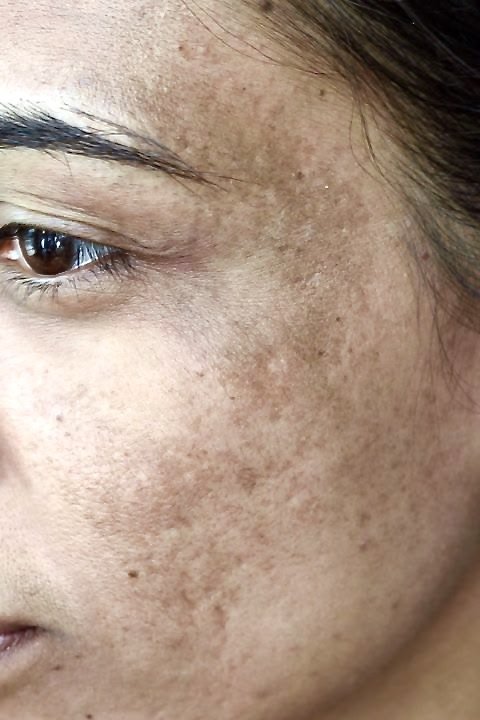
But let's say the damage is already done. You've got stubborn pigmentation, you've been using your Vitamin C and your AHA exfoliator, but nothing seems to be fading. So you start asking yourself, what am I doing wrong? Maybe you keep covering it with foundation, hoping it'll fade on its own over time.
I'm sorry, but unfortunately, that's not really how it works.
The 3 stages of pigmentation
When it comes to treating pigmentation with skincare, the first thing to understand is that pigmentation forms in three distinct stages, and each one needs a different approach.
The first stage is melanin production. We need to regulate this directly, which is where tyrosinase inhibitors come in. Think of them as little helpers that suppress melanin production at the source.
The second stage is the transfer of that melanin to the deeper layers of the skin, where the pigmentation settles in and stays. To help prevent this, niacinamide (Vitamin B3) is incredibly useful.
The third stage is improving cellular turnover, which helps existing pigmentation fade faster. This is where retinol and AHAs do their best work.
Treating pigmentation in-clinic
When it comes to actually treating pigmentation in the clinic, my number one pick is skin needling, done every 6 weeks as the main treatment, paired with a Jessner peel or another TCA peel where the resurfacing process is significant. Lasers can also be quite effective, but they come with more risk for darker skin tones (Fitzpatrick III, IV, and V), and they often need more sessions because the laser intensity has to be turned down to avoid complications on darker skin. Skin needling, on the other hand, is safe for any skin type, and peels like the Jessner are also safe for darker skin tones, with genuinely amazing results when it comes to lifting pigmentation.
Another thing worth knowing: when you treat your skin with skin needling, you're not just targeting pigmentation the way laser does. You're also boosting collagen production by up to 400% and improving overall texture, think smaller-looking pores and a smoother surface overall. In other words, you're improving your skin's general health with one treatment, instead of paying for just one concern at a time.
That second part is genuinely a strong selling point, worth keeping front and centre, since it reframes skin needling from "a pigmentation fix" to "better value than a single-concern treatment," which is a compelling reason for someone to choose it over laser.
Pigmentation isn't permanent, and with the right skin plan, you don't have to choose between fixing it and improving everything else.
If you're dealing with stubborn pigmentation, melasma, or sun damage and you're in Sydney looking for a treatment that actually works, not just another cream that promises results, book a consultation with me at ReSKN Studio in Woollahra.
